ExtAnt Poster presented at Royal Society Meeting in London: ‘Global impacts of climate extremes in the polar regions: is Antarctica reaching a tipping point?’

Over two days at the end of September 2025, the Royal Society in London hosted a dedicated event on ‘Global impacts of climate extremes in the polar regions: is Antarctica reaching a tipping point?’ (https://royalsociety.org/science-events-and-lectures/2025/09/polar-regions/). The occasion brought together experts from a range of disciplines, to discuss the fragility and global importance of Antarctica in a changing climate, with a particular emphasis on extremes. The consensus is that extremes in Antarctica play a big role in the timing of key events (e.g., ice shelf collapse) with implications both locally (e.g., on species distribution and abundance) and globally (e.g., sea level rise) to give just a couple of examples. Such events may yield irreversible consequences (hence ‘tipping points’) but there is still huge uncertainty that we as a community still need to work to unravel.

The agenda featured a series of overview talks on the current ‘State of Play’ from leaders in their respective fields, pitched to a general scientific audience, with further sessions on specific aspects including ‘Lessons from the past’, ‘Future projections and uncertainties’ and ‘Policy and societal requirements, and how they can be met’. Towards the end of each session, a panel discussion was held to engage the audience on addressing key issues (e.g., existing knowledge gaps and future research priorities needed). In addition to tea and coffee breaks, a poster session offered a chance for networking and particularly helped involve early career researchers. Poster presenters were also offered the chance to give a 2-minute flash talk to advertise and attract attention to their poster.

I presented a poster on the Antarctic weather extremes database I am currently building in ExtAnt, which I found to be of very broad interest at the meeting. The poster included information on the different data sources I’m using (observations and state-of-the art high-resolution model outputs), including the different variables available to me. I briefly explained the methodology in which I am identifying extremes, using language more accessible to non-specialists, and outlined the proposed content and structure of the database (which will be archived for others to use). I also shared an example of some ongoing scientific analysis looking into changes in extremes through time (2000-2020), according to preliminary output from the database. For context, I highlighted the different characteristics and impacts during the February 2020 heatwave that affected the Antarctic Peninsula, in which the highest temperature ever recorded on the continent occurred (18.3°C). I had many interesting conversations with people and received more specific requests from potential end-users. It was exciting to learn just how much others are looking forward to using the database in their work!

The event was hybrid and free to attend, even enticing a few members of the public to come along and ask questions. The organisers did a brilliant job putting together the programme and hosting the event! A standout aspect for me was session chairs opening the floor first to early career researchers for questions, which is perhaps something that should be adopted more widely at conferences. Not only can it be sometimes daunting to ask questions, but all too often more senior experts raise their hand immediately and/or repeatedly. And they perhaps know the speaker or session chair on a personal level, so unconscious bias can be a factor in who gets picked to ask their question.

Article written by Ryan Williams

ExtAnt Paper on ‘Antarctic extreme seasons under 20th and 21st century climate change’

A paper was recently published entitled ‘Antarctic extreme seasons under 20th and 21st century climate change’. The paper provides the first overview of the evolution of extreme seasons over Antarctica and the Southern Ocean during the 20th and 21st centuries.

Many of the major impacts of climate change are associated with changing intensity and frequency of weather extremes. Vulnerable ice shelves are at most risk of collapse during extreme conditions, with consequences for global sea level. Unique ecosystems can come under greatest strain during extreme conditions. For example when rain falls instead of snow penguin breeding can be severely affected.    

The columns show, from left to right, cold extremes (p10) (aei), background mean climate (background_clim) (bfj), warm extremes (p90) (cgk) and the differences between warm and cold extremes (i.e. the 3rd column minus the first column) (dhl). The box with bold black borders shows the location of the north Peninsula region referred to in the main text and used in time series plots in Fig. 4. The box spans the latitudes 62.5°S–67.5°S and longitudes 70°W–57.5°W.

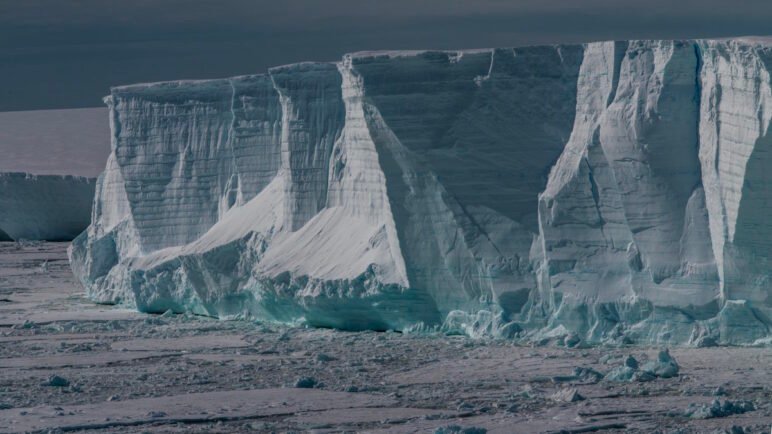
A cool rainy day may not seem like an extreme weather event to us in the UK. However, in Antarctica, a continent of ice and snow, a rainy day is an extreme weather event with potentially catastrophic impacts for delicately balanced physical and biological systems. Indeed extreme weather and climate events, whereby conditions differ considerably from normal for a given location, are key to understanding many aspects of how climate change could affect, and is affecting, Antarctica and the planet. Occasions when extreme conditions persist over a sustained period, such as a season, are of particular relevance to impacts as they can produce accumulated effects of greater impact than a single weather event. For example, the breakup of ice shelves and subsequent impacts on global sea level or severe impacts on penguin breeding.

New research just published has provided the clearest picture yet of how extreme seasons may change, and are changing, in a warming world. The work used state-of-the art climate model simulations to build a comprehensive picture of changing seasonal extremes in temperature, precipitation and wind. A key overall message is that changes in extreme seasons do not in general follow change in background climate. The characteristics of these differences vary considerably across temperature, precipitation and wind and between summer and winter. A key implication is that we cannot, for example, assume that the severity of extreme melt seasons over ice shelves will follow background mean conditions.

More specifically, the research shows that the regional picture of changing temperature extremes is, at many key locations, strongly controlled by changes in sea ice. Possibly of greatest relevance to the global climate system is that poleward-shifting storm tracks in austral summer reduce the range in seasonal wind extremes over large parts of the Southern Ocean, where wind variability is thought to be an important driver of variability in the Southern Ocean carbon sink.

This research sets the stage for further detailed quantitative studies of the impacts of changing Antarctic extremes and their local and global impacts. In particular two major UKRI-funded projects are now underway to address these very issues. These are ExtAnt, led by BAS, and PICANTE, which includes significant BAS involvement.

Read the full article here.

Article written by Thomas Bracegirdle

ExtAnt Project Kick Off Meeting

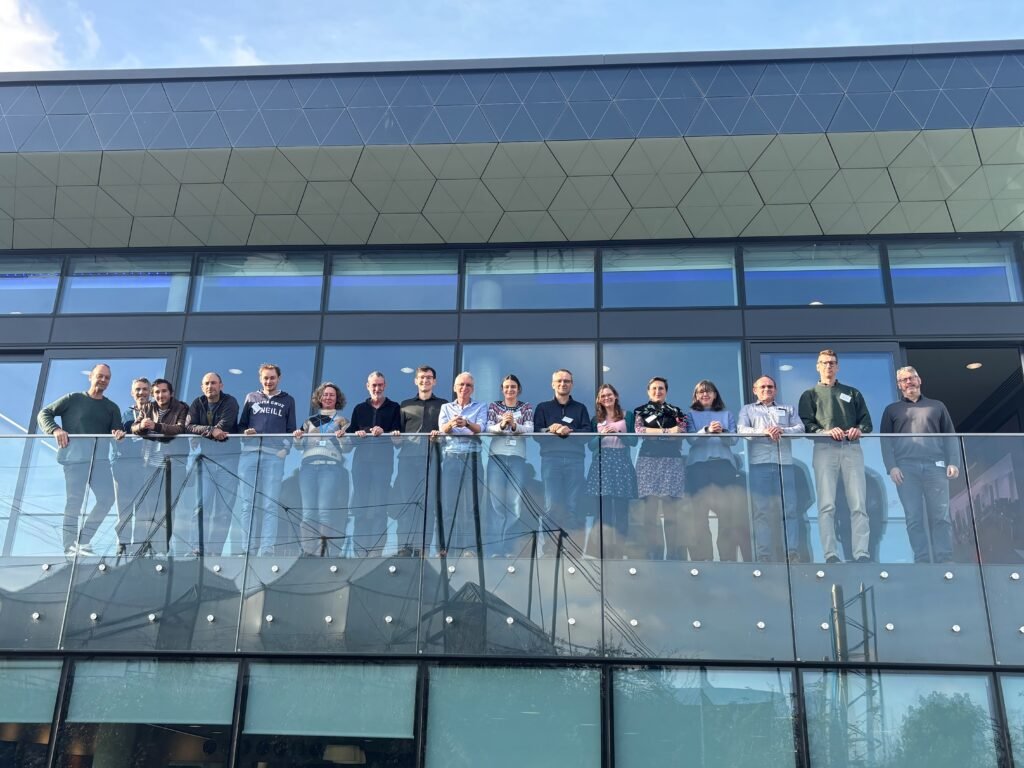
In November researchers collaborating on ExtAnt (Drivers and Impacts of Extreme Weather Events in Antarctica) were at BAS Cambridge for the project kick off meeting.

ExtAnt is a 4-year NERC: Natural Environment Research Council project assessing present day and future extreme weather events in Antarctica, and the associated risks.

The project brings together leading UK and international scientists to:
🌪️ Investigate the drivers of extreme weather events
📈 Understand present-day trends of extreme events and their impacts
🧊 Quantify the severity and frequency of future Antarctic extreme events, and impacts on vulnerable ice shelves

Article Written by The Communication Team at BAS